I got my ADHD diagnosis as an adult. My first response wasn't relief. It wasn't even grief. It was something closer to "tell me something I don't already know."
Because somewhere underneath all the years of thinking I was lazy, broken, unreliable, I already knew. The relationships that hollowed out. The financial cost of launching brilliantly and struggling to scale. The pattern was obvious. I just didn't have a name for it yet.
What the diagnosis actually gave me wasn't an explanation. It was permission. Permission to stop fighting my own operating system and start building one that actually worked.
I work at the intersection of ADHD, nervous system regulation, breathwork, and lifestyle optimisation, and alongside Candice, mind training and creating conscious relationships.
The question I keep returning to.. Is my brain a liability in the world AI is building, or exactly what that world needs?
I went deep on the research. What I found surprised me, challenged me, and genuinely stung.
What AI is actually automating
The 20th knowledge economy was structurally one of the worst habitats for an ADHD brain. It rewarded sustained linear attention, rule following, and executive function, precisely the profile ADHD research shows us struggling with most. AI is now automating that.
Work is moving toward augmentation, not replacement. What increases in value: judgement, behaviour change, emotional regulation, relationship navigation. What collapses: information, advice, templates, generic coaching. Map the ADHD brain onto the first list. Rapid reframing. Real comfort in ambiguity. Pattern sensing in the relational loops others miss. The dominant cognitive task profile of twentieth-century work was the worst match for the ADHD brain. AI is breaking that mismatch.
The deeper problem is not ADHD. ADHD is the sharpest expression of it. ADHD brains feel it first. Navigate it well and you are a few years ahead of most people in the room.
What this means for lifestyle optimisation
The ADHD brain runs on an interest-based nervous system. Dopamine at baseline is lower. The standard advice, build habits, be consistent, just do the thing, fails not because of motivation but because of neurobiology. You can know every protocol and still not follow it. Not because you are weak, but because executive function cannot bridge intention and action without external support.
AI closes that gap: habit tracking, externalised working memory, accountability. Regulation by design, not by discipline. But used carelessly, AI plus novelty plus content becomes the most sophisticated avoidance mechanism ever built. Less depth. Less presence. All disguised as 'productivity'.
What it costs the person closest to you
I am in a relationship with someone I love deeply, who understands the ADHD brain better than almost anyone I know. And still, my ADHD had its cost.
For ADHD couples, new love is dopaminergic gold. Full presence, relentless attentiveness, the feeling of being completely alive in someone's orbit. What nobody prepares either partner for is what happens when that neurological high settles.
For the neurotypical partner it feels like the relationship cooling. For the ADHD partner it can feel like the relationship is fading. Both are misreads. The sharp responses from nowhere, the withdrawal that looks like indifference but is overwhelm, the silence filled with a new project instead of presence, these are not character flaws. They are the predictable output of a dysregulated nervous system in close quarters.
Most ADHD couples are not failing at love. They are failing at nervous system regulation, and nobody told them that was the real problem.
The pitfalls worth naming
Loneliness among ADHD adults is nearly two and a half times more likely than in the general population. 89% feel lonely even when surrounded by people. I can hold a room of thirty in a retreat and still feel a quiet aloneness underneath it. Great at intensity. Harder at maintenance.
Hyperactivity predicts launching; inattention predicts worse outcomes post-launch. We start brilliantly. Scaling is where it falls apart. The knowing-doing gap is the most uncomfortable one: I teach nervous system regulation for a living. Do I live it as consistently as I teach it? Honestly, not always.
The pitfall that gets worse before it gets better: high activation, low sustainment. ADHD brains risk mistaking AI-generated novelty for the slow work of building something that lasts. Isolation disguised as productivity. Stimulation disguised as growth.
5 takeaways that might help you...
Build environment, not willpower.Willpower is one of the most unreliable resources an ADHD brain has. On a low-dopamine morning it is simply not coming. So the real work is making the right thing the easiest thing. Cold showers instead of going to a cold plunge suite. Scheduled breath work and meditation on your calendar (or using Manus). Movement breaks when the 30min pomodoro is up. Gym bag packed the night before left in the car. You are not trying to be more motivated. You are engineering an environment that works with your neurology instead of against it.
Design your lifestyle for dopamine, not discipline.The ADHD brain is always going to seek dopamine. The question is whether you give it the real kind or the cheap kind. Cheap dopamine (alcohol, ultra-processed food, pornography, endless scrolling, sometimes medication used as a shortcut) spikes fast and crashes hard. Real dopamine, built through cold immersion, breathwork, and high-intensity training, fuelling with nutrient diversity + density for optimised gut health... raises your baseline rather than borrowing from it. Movement before creative work; breathwork before relational work.
Use AI for connective tissue. Protect human time for depth. AI is genuinely good at the things the ADHD brain finds most aversive: admin, follow-up, scheduling, repetitive communications. Let it do those. But the moment you start outsourcing your emotional processing or relational presence to an AI, you are feeding the avoidance pattern that already costs you. The human in front of you who needs you to show up, that is where AI cannot go. Guard that territory.
Treat stillness as a relational skill, not an absence. When dopamine drops, the ADHD brain reads quiet as threat and starts scanning for stimulation. The people closest to you rarely get the experience of being truly sat with, they get the distracted version, body present, mind elsewhere. 10 minutes of genuine unoccupied presence daily is not a meditation practice. It is a relational practice. It is harder than it sounds.
Regulate first. Relate second. Reprogram third. Most ADHD adults attempt behaviour change, relationship repair, or identity work from inside a dysregulated nervous system and wonder why nothing sticks. A brain running on cortisol and low dopamine cannot access the resources needed for insight, empathy, or sustained change. The breathwork, the cold, the movement, the sleep are not indulgences. They are the neurological conditions under which real work becomes possible.
The ADHD brain is well-matched to the economy AI is building, but only when paired with the scaffolding it cannot generate internally. The risk is not that this field disappears. The risk is getting mistaken for content instead of transformation.
For me, that means doing the same work I ask of everyone. Prioritising sleep and recovery. A plant-focussed diet. Daily training. Unpacking the shame underneath the diagnosis. Leaning into emotional discomfort instead of sprinting toward the next stimulating thing. Listening more than I speak. Trusting instead of controlling.
And...Slowing down, being ok with stillness.
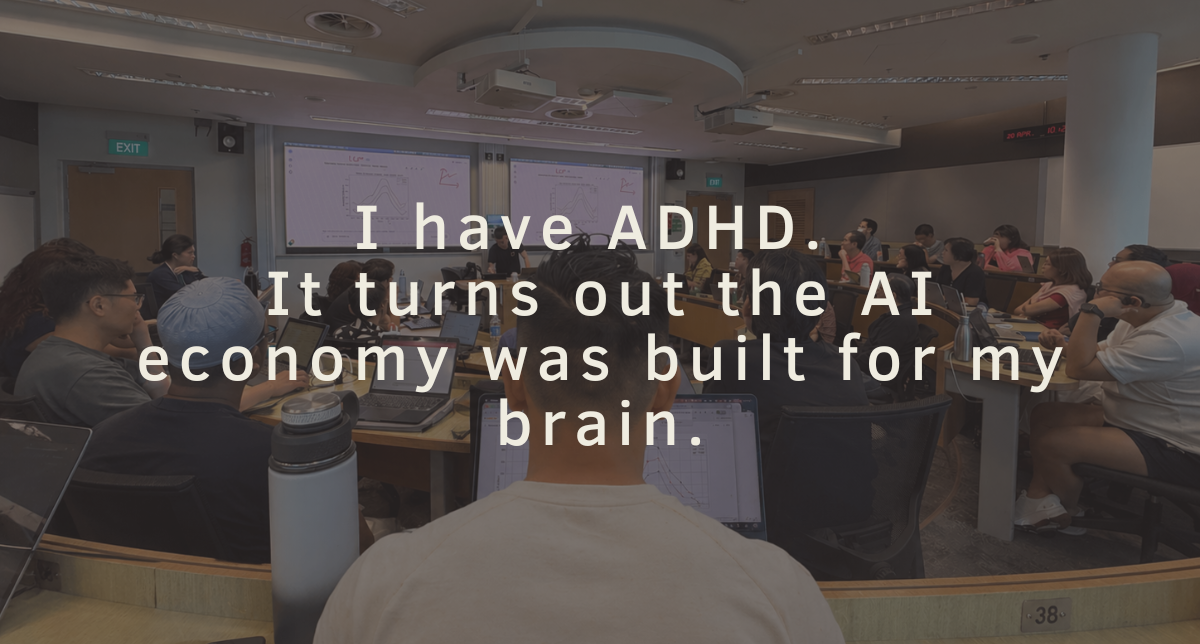
P.S: I researched and wrote this during a break at a Generative AI course. The future is being built in rooms like this one. The question is whether we bring our full humanity into it, or just our productivity.
If this landed for you..
We work at the intersection of ADHD, nervous system regulation, breathwork, and relationship depth, through the Free Human Project. If you are navigating a late diagnosis or building a life that works for your work, life and relationships, I would love to connect.